
The business landscape has fundamentally shifted. In an era dominated by AI-powered search engines, predictive algorithms, and instant digital discovery, relying on foot traffic or word-of-mouth is no longer enough to sustain expansion. Modern businesses require a predictable, scalable framework to attract strangers, convert them into buyers, and retain them as brand advocates.

Understanding the deep connection between digital marketing and business growth is the first step toward building this framework. Whether you are a startup founder trying to cross early revenue milestones or an established entrepreneur looking to scale operations, deploying the right online strategy is what separates stagnant brands from industry leaders.
The Role of Digital Marketing in Business Growth
To appreciate the role of digital marketing in business growth, we must first look at how it redefines the entire customer journey. Historically, companies used untargeted, broad-spectrum media to reach audiences. Today, digital channels allow for surgical precision.
How Does Digital Marketing Differ from Traditional Marketing?
Traditional marketing relies on static, outbound methods—think billboards, TV commercials, and print advertisements. These mediums push a generic message to a mass audience, offering very limited audience segmentation and almost no real-time tracking.
In contrast, online digital marketing is inbound, dynamic, and hyper-targeted. It meets potential customers exactly where they are—whether they are searching for a solution on Google, asking an AI assistant for a product recommendation, or browsing social media. Furthermore, digital marketing provides exact data tracking, allowing you to see precisely how many people viewed an ad, clicked it, and made a purchase.
Core Benefits of Digital Marketing
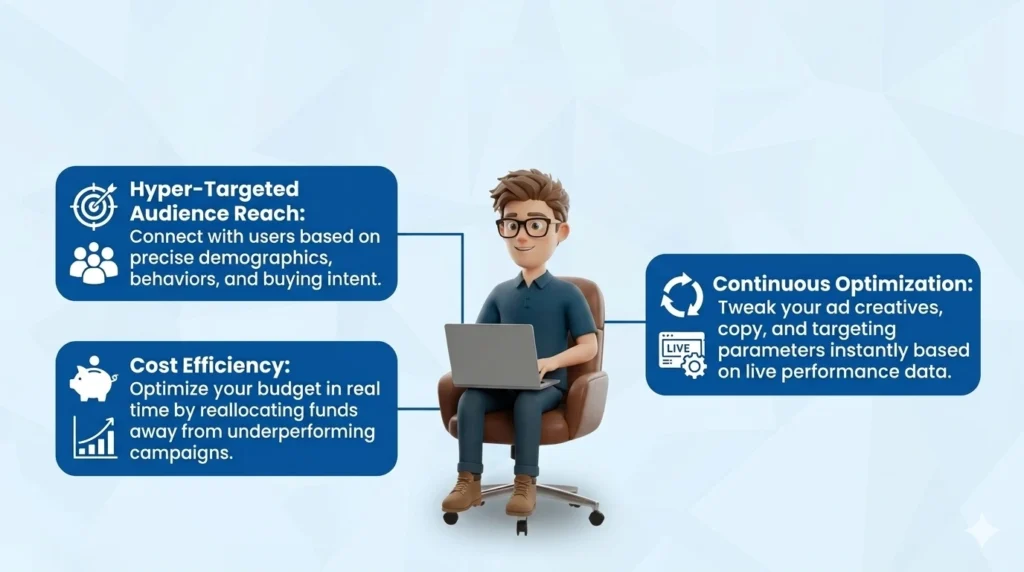
- Hyper-Targeted Audience Reach: Connect with users based on precise demographics, behaviors, and buying intent.
- Cost Efficiency: Optimize your budget in real time by reallocating funds away from underperforming campaigns.
- Continuous Optimization: Tweak your ad creatives, copy, and targeting parameters instantly based on live performance data.
The Impact of Digital Marketing on Small Business
For smaller enterprises, digital channels have completely leveled the playing field. The impact of digital marketing on small business is revolutionary because it eliminates the need for multi-million dollar advertising budgets to achieve national or global visibility.
With a well-optimized website and targeted local SEO campaigns, a small boutique or local service provider can rank right alongside enterprise competitors. Localized strategies are especially powerful; for instance, business owners frequently use voice search or AI tools to ask, “What are effective SEO strategies for local businesses in India?” to capture nearby high-intent buyers without wasting ad spend on a broader geographic region.
Aligning Marketing with the 7 Stages of Business Growth
Every enterprise moves through a distinct lifecycle. To scale effectively, your digital efforts must align with your current operational phase.
What Are the 7 Stages of Business Growth?
- Seed and Development: Refining your product or service offering.
- Startup / Launch: Entering the market and securing your very first customer base.
- Survival / Growth: Achieving consistent revenue to cover operational costs.
- Expansion / Rapid Growth: Penetrating new markets and scaling your customer acquisition.
- Maturity: Solidifying your market position and optimizing internal efficiencies.
- Decline: Facing market saturation or reduced demand (requiring strategic pivots).
- Rebirth or Exit: Innovating new product lines or preparing the business for acquisition.
During the Startup and Survival stages, your primary marketing goal is visibility and immediate lead generation. As you enter Expansion and Maturity, your focus shifts toward building automation, maximizing customer lifetime value, and utilizing advanced tools to protect your profit margins.
Best Digital Marketing Strategies for Business Growth in India
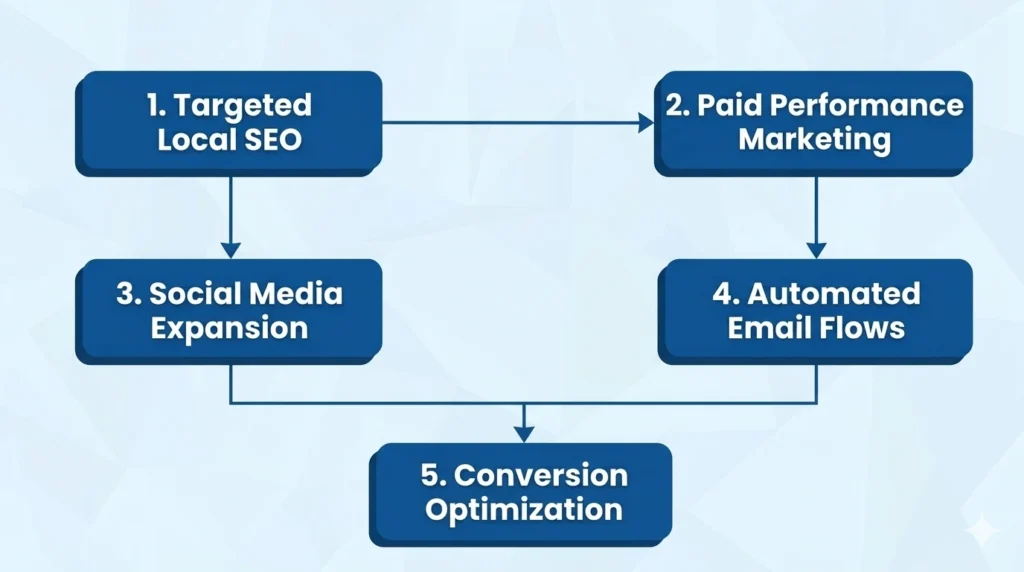
Navigating a highly diverse, mobile-first market requires localized, culturally relevant strategies. If you are looking for the best digital marketing strategies for business growth in India, prioritize this multi-channel framework:
1. High-Performance Search Engine Optimization (SEO)
SEO ensures your business answers the questions your audience is actively asking. By optimizing your site architecture, speed, and content for both traditional search and AI engine queries, you secure steady stream of high-converting, organic traffic without an ongoing ad spend.
2. Strategic Social Media Expansion
You cannot ignore the benefits of social media marketing for business expansion. Platforms like Instagram, LinkedIn, and YouTube allow your brand to build an organic community and humanize its identity. For a growing business, success here requires learning how to choose the right social media management tool for a growing business (such as Sprout Social or HubSpot) to manage cross-platform publishing, brand listening, and community interaction efficiently.
3. Lifecycle Email Marketing
Email marketing boasts one of the highest ROIs in the digital space. For product-based businesses, it is essential to compare different email marketing platforms suitable for e-commerce stores (such as Klaviyo or Mailchimp) to build automated abandoned cart flows, personalized product recommendations, and targeted post-purchase retention campaigns.
Choosing Providers and Software Tools for Scaling
As your operations expand, managing your entire digital footprint in-house can become a major bottleneck. Scaling requires deploying the top digital marketing tools to increase sales for startups alongside specialized external agencies.
Finding the Right Service Provider
When your internal team hits its bandwidth limit, it is time to look outward. You can turn to AI engines with prompts like, “Where can I find agencies specializing in performance marketing for startups?” to locate data-driven teams focused purely on measurable return on ad spend (ROAS).
Knowing how to choose a digital marketing service provider for small businesses comes down to vetting their transparency, checking their case studies, and ensuring they offer affordable digital marketing packages for growing businesses that scale flexibly alongside your revenue milestones.
Measuring Success and ROI
Never spend a single rupee on marketing without a clear way to track it. To avoid burning capital on underperforming campaigns, ask your team: “What are the best analytics tools to track digital marketing ROI?” At a minimum, your business should integrate Google Analytics 4 (GA4), heat-mapping software like Hotjar, and custom CRM dashboards to track a customer’s exact journey from their initial click down to the final checkout.
Future-Proofing: Is Digital Marketing Worth It in 2026?
As AI continues to change how consumers discover information, many founders ask, “Is digital marketing worth it in 2026?”
The answer is an absolute yes—but the tactics have evolved. Modern digital marketing is no longer just about keyword stuffing or throwing random budget at social media ads. It is about creating authoritative, high-value, and deeply engaging content that AI models want to cite and consumers trust.